Kalaripayattu
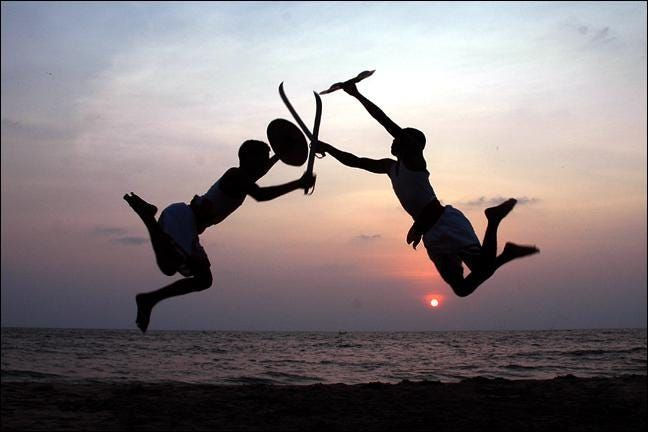
Perched high above the Arabian Sea on the dramatic red laterite cliffs of Varkala, the rhythm of coastal life changes as dusk approaches. The gentle crash of waves against the shore of Papanasam Beach mingles with a distinct, resonant heartbeat: the strike of wooden sticks, the clatter of iron shields, and the focused exhalations of martial artists practicing India’s oldest combat discipline.
Welcome to the world of Kalaripayattu, an ancient, sacred tradition that transcends mere fighting to become a profound physical art form, living philosophy, and healing science. For foreign travelers unwinding along the bohemian walkways of Varkala’s North Cliff, taking an evening to witness a live demonstration offers an unforgettable journey into Kerala’s warrior heritage. Whether you are in town for surfing, yoga teacher training, or peaceful cliffside sunsets, experiencing Kalaripayattu will transform how you perceive the energy, grace, and history of southern India.
Quick facts
Origins: Kerala, South India; recognized globally as one of the oldest surviving martial arts in the world.
Core Philosophy: Mei thirannu kanne aavuka ("The body becomes all eyes"), cultivating supreme sensory awareness.
The Arena (Kalari): A consecrated, sunken earthen training pit constructed with traditional clay, sand, and medicinal herbs.
Main Styles: Vadakkan (Northern style, famous for dynamic high kicks, acrobatics, and elegant weaponry) and Thekkan (Southern style, known for grounded footwork and pinpoint pressure-point strikes).
Key Weapons: Kettukari (long bamboo staff), Cheruvadi (short stick), Churika (dagger), Valum Parichayum (sword and shield), and Urumi (flexible, whip-like steel sword).
Typical Show Duration: 45 to 60 minutes for tourist demonstrations; full training sessions last several hours.
Healing System: Deeply entwined with Kalari Chikitsa, a specialized branch of Ayurveda incorporating deep-tissue foot-massage (Chavitti Uzhichil) and herbal bone-setting.
Why it matters for Varkala visitors
Varkala is celebrated worldwide for its laid-back backpacker aura, beach shacks serving fresh catch, and holistic Ayurvedic retreats. Yet beneath its leisurely surface lies deep cultural and spiritual significance. Papanasam Beach is renowned as a sacred site where holy waters wash away sins, overlooked by the ancient Janardhana Swamy Temple.
Adding Kalaripayattu to your Varkala journey bridges the gap between passive sightseeing and active cultural immersion. Just as yoga cultivates internal stillness, Kalaripayattu demonstrates dynamic meditation in full kinetic motion. For travelers dedicated to wellness, watching these practitioners execute soaring leap kicks and fluid animal postures provides profound inspiration. It grounds your coastal holiday in the genuine artistic fabric of Kerala, offering an exhilarating evening spectacle just steps away from candlelit beach cafes.
Origins and history
Kalaripayattu traces its lineage back over two millennia, with deep roots embedded in the Sangam literature of South India. The word Kalari translates to an arena, threshing floor, or battlefield gymnasium, while Payattu means combat exercise or fighting. Historically, it was the formal warrior discipline practiced by feudal soldiers and mercenary guilds across medieval Kerala, including the legendary Chekavars and Nairs.
Between the 11th and 16th centuries, during periods of intermittent warfare among feudal kingdoms like Calicut, Kolathunadu, and Venad, Kalaripayattu flourished as an indispensable art of state defense and community honor. Ballads known as Vadakkan Pattukal (Northern Ballads) still celebrate mythic warriors like Thacholi Othenan and fearless warrior-women such as Unniyarcha, who defended their dignity with flashing steel blades.
During the British colonial era, the art faced existential peril. Following uprisings against imperial rule, British administrators banned Kalaripayattu in 1804, outlawing traditional weapons and shutting down village kalaris under threat of severe punishment. Undeterred, masters kept the flame alive in secrecy, practicing in remote forest clearings and basement chambers. By the 1920s, during a resurgence of cultural renaissance across South India, pioneer gurukkals (masters) revived the art, formalizing its syllabus and presenting it to the wider world as a supreme emblem of Indian physical heritage.
Performance elements
Costume and makeup
Unlike the elaborate, hours-long paint and papier-mâché masks of Kathakali, Kalaripayattu honors an aesthetic of stripped-down, practical athleticism. Practitioners traditionally train barefoot, bare-chested, or wearing fitted vests. They bind their loins in a Kacha, a single piece of cotton cloth measuring several meters long, wrapped tightly around the waist, groin, and hips through an intricate tying technique. This binding protects vital organs, supports the lower back, and permits unhindered hip mobility.
Before stepping into the arena, practitioners coat their limbs in cooling sesame oil or herbal Ayurvedic formulations (Dhanwantharam thailam). This gives the skin a radiant, polished sheen under the lights, shields muscles from friction burns during sweeping ground sweeps, and keeps joints supple.
Music & instruments
A traditional demonstration is accompanied by dramatic, primal acoustic accompaniment that dictates the pacing and tension of each bout:
Chenda: The cylindrical Kerala wooden drum, played with curved sticks to produce roaring, thunderous rhythms during duels.
Elathalam: Heavy bronze hand cymbals that provide crisp, metallic timekeeping.
Vaithari: The rhythmic oral commands and chants vocalized by the presiding Gurukkal. These rhythmic syllables guide the rhythm of the duelists’ footwork, strikes, and evasions like a spoken musical score.
Movement
The choreography of Kalaripayattu draws its geometry directly from nature. Central to its movement vocabulary are the Ashta Vadivukal, or eight sacred animal stances:
Gaja Vadivu (Elephant stance): Heavy, rooted stability and immense crushing force.
Simha Vadivu (Lion stance): Poised, coiled chest-forward readiness to spring.
Aswa Vadivu (Horse stance): Dynamic linear speed and sudden forward advances.
Sarpa Vadivu (Serpent stance): Low-slung, coiling defensive maneuvers along the floor.
Marjara Vadivu (Cat stance): Silent, agile, spring-loaded foot changes.
Kukkuda Vadivu (Rooster stance): Swift, sharp pecking strikes and rapid evasions.
Varaaha Vadivu (Boar stance): Relentless, bulldozing drive.
Matsya Vadivu (Fish stance): Serpentine, elusive twisting escapes.
Performances transition through progressive stages: Meithari (bare-handed calisthenics, flexibility kicks, and acrobatic jumps), Kolthari (short and long wooden stick duels), Angathari (lethal metal weapon bouts), and finally Verumkai (empty-handed disarmament and lethal strike defenses).
Mythology and repertoire
In regional mythology, the origin of Kalaripayattu is attributed to Lord Shiva and preserved by Sage Parashurama, the sixth avatar of Vishnu. Legend recounts that Parashurama heaved his battle-axe from Gokarna into the sea, commanding the waters to part, thereby creating the lush land of Kerala. To defend this new realm from malevolent forces, Parashurama instructed twenty-one chosen disciples in Kalari vidya and erected initial training arenas across the state.
A full exhibition repertoire takes audiences on an escalating journey of physical danger and mastery:
The Vandanam: A reverent opening prayer where fighters touch the earth and salute the Poothara (a seven-tiered altar representing the chakras and divine elements), their master, and the spectators.
Staff & Stick Combat: Rhythmic, lightning-fast duels with long rattan sticks (Kettukari) and curved cudgels (Muchan), cracking together with startling acoustic power.
Dagger and Shield (Churika): Close-quarter defensive maneuvers showcasing knife deflections and grappling.
Broadsword and Buckler (Valum Parichayum): High-flying sparks fly as heavy metal swords clash against burnished brass-studded shields.
The Feat of the Urumi: The climax of the evening, featuring the dreaded whip-sword. Warriors whirl double-edged, flexible bands of ribbon steel around their torsos at lethal speeds, transforming their bodies into human buzz saws.
Fire Leaps: Senior practitioners dive through blazing hoops of fire, demonstrating fearlessness and spatial mastery.
Famous artists, schools and local contacts
Kerala’s martial heritage is safeguarded by venerated lineages, living masters, and established institutions:
Celebrated Regional & National Figures and Academies
Meenakshi Amma (Padma Shri): Revered worldwide as the octogenarian doyenne of Kalaripayattu, heading the Kadathanad Kalari Sangham in Vadakara.
Sreedharan Nair Gurukkal: A historic pioneer who popularized the art globally and helped systematically codify northern-style curriculum techniques.
C.V.N. Kalari Sangham (Thiruvananthapuram): One of Kerala’s most renowned apex institutions, founded by C.V. Narayanan Nair, instrumental in standardizing modern training and Kalari healing.
ENS Kalari (Nettoor, Kochi): Celebrated training ground and traditional medicine clinic led by veteran masters.
Hindustan Kalari Sangham (Calicut): World-renowned school nurturing cross-cultural exchange and elite international martial artists.
Balan Gurukkal: Esteemed regional master known for lifelong dedication to preserving southern Marmashastram (vital point systems).
Local Varkala Contacts & Venues
[Varkala Cultural Centre]
[Varkala Kathakali & Martial Arts Club]
Where to watch in/near Varkala
North Cliff Cultural Venues: Stroll along the paved pedestrian path of Varkala’s North Cliff, where intimate performance centers showcase combined evenings of Kathakali makeup demos followed by Kalaripayattu exhibitions. These compact venues bring you mere feet away from the action.
South Cliff & Helipad Area: Several local arts collectives and retreat centers near the Varkala Helipad and South Cliff host seasonal cultural programs during the high tourist season (November through March)
Thiruvananthapuram City (Day Trip): Located approximately 45 kilometers south of Varkala (an easy 45-minute train ride), the capital city houses the famous C.V.N. Kalari in East Fort. Visiting this traditional pit arena during early morning training hours (6:00 AM – 8:30 AM) offers an authentic, unchoreographed glimpse into daily master-disciple training.
Varkala itineraries
The 24-Hour Express Cultural Tour
Morning: Rise early for sunrise over the Arabian Sea at South Cliff, followed by a light South Indian breakfast of dosas and filter coffee.
Midday: Visit the 2,000-year-old Janardhana Swamy Temple; enjoy a swim at Odayam Beach away from the central crowds.
Sunset: Settle onto a cliffside cafe terrace on North Cliff to watch the sun melt into the horizon.
Night: Attend an intimate 6:30 PM Kalaripayattu show at a local cultural venue, then dine on tandoori fish at a nearby sea-view tavern.
The 48-Hour Heritage & Wellness Weekend
Day 1: Arrive, rent a scooter, explore the sweeping black sand at Black Beach, and book an evening front-row seat for the Kalaripayattu and Kathakali demonstration.
Day 2: Start with an introductory morning Kalari workshop or seaside yoga session. Book an afternoon rejuvenating Kalari Chikitsa herbal oil massage to relieve muscle tightness. Conclude with a sunset kayak trip on the tranquil backwaters of nearby Kappil Lake.
Visitor experience & etiquette
Stepping inside a performance space invites you into an environment treated as a temple of physical discipline:
Footwear Removal: Always remove your sandals, shoes, or flip-flops outside the venue doors.
Seating: Most venues offer tiered bench seating or floor cushions encircling the demonstration pit. Arrive 15–20 minutes early to secure an unobstructed front-row view.
Audience Decorum: While gasps and respectful applause are welcome after complex acrobatic feats or weapon exchanges, maintain silence during combat bouts so martial artists can hear the master’s voice and focus on safety.
Dress Modestly: Dress casually and comfortably for tropical humidity, but keep shoulders and knees respectfully covered.
Workshops and hands-on options
If sitting in the audience gives you an urge to move, many local instructors in Varkala and surrounding villages offer beginner-friendly introductory workshops. Typically lasting 90 minutes to two hours, these sessions focus on:
Fundamental body conditioning and dynamic leg swings (Kaalukal).
Basic animal postures (Vadivukal) designed to build core balance and lower-body stability.
Defensive evasion postures and staff-spinning basics.
Wear flexible, breathable gym wear (leggings or sports shorts and a T-shirt). Bring plenty of drinking water and a small towel, as traditional training is an intense cardiovascular workout in Kerala’s coastal warmth.
Photo suggestions
The Shield Clash: Position yourself low to capture the dramatic split-second impact when brass-studded shields collide, catching stray sparks and intense facial focus.
The High Leg Extension (Ner Kaal): Frame the performer from a wide angle against the red brick walls of the arena as their foot kicks vertically overhead with mathematical precision.
Urumi Motion Blur: Adjust your camera or smartphone shutter to capture the circular sweep of the ribbon sword, turning spinning steel into a gleaming halo of light.
Local logistics
Getting to Varkala: Varkala Sivagiri Railway Station (VAK) is well connected by express trains from Trivandrum International Airport (TRV, ~45 km away) and Cochin International Airport (COK, ~180 km away). Pre-paid taxis and auto-rickshaws are readily available at the station.
Getting Around Town: Auto-rickshaws are the easiest way to hop between the railway station, the temple precinct, and the cliffs. For independent exploring, hire an automatic scooter along North Cliff (carry an international driving permit).
Booking Shows: Walk-in tickets are often available during off-peak periods, but reserving in the afternoon for that evening’s performance is recommended between December and February.
Admission Fees: Standard entry tickets typically range from ₹300 to ₹500 ($4–$6 USD) per person.
FAQs
How long is a typical performance?
A standard tourist demonstration lasts between 45 and 60 minutes. The program opens with a brief contextual introduction and warm-up calisthenics, moves through bare-handed and wooden weapon forms, and culminates in thrilling metal weapon duels and fire exhibitions.
What should tourists wear and expect?
Wear lightweight, loose-fitting, breathable cotton clothing suited for humid indoor conditions, as traditional performance halls are fan-cooled to preserve the sacred arena ambiance. Expect sudden loud noises from striking wooden sticks, clattering metal swords, and ringing drums.
Can I take photos?
Yes, non-commercial photography and mobile video recording are permitted in almost all tourist venues. However, turn off your camera flash completely; sudden bursts of bright light can blind or distract duelists wielding live, sharp blades.
How to book tickets or workshops?
Tickets can be bought directly at venue box offices along the North Cliff walkway during the afternoon, or arranged through your hotel travel desk. For hands-on workshops, speak directly with the venue master after an evening show or consult cliffside yoga centers that coordinate morning guest lessons.
Are there English explanations during performances?
Yes. The majority of performance venues catering to international visitors provide clear spoken introductions and ongoing commentary in English, breaking down the history, animal stances, and specific weapons before each demonstration begins.
The rhythm of the drums is calling, and the clattering swords are waiting to tell their age-old stories. Step away from the sun loungers for an evening, take your front-row seat on the cliff, and witness the timeless warrior spirit of Kerala come alive. Book your tickets at a Varkala cultural center tonight, or ask your guesthouse host to arrange your first hands-on morning workshop!


Comments